OWASP Agentic AI Top 10 Coverage
Mapping the OWASP Agentic AI Top 10 to Molecule AI security controls — honest coverage report.
Overview
The platform's primary access-control mechanism is hierarchy-based: the org chart itself is the policy that governs which agents may communicate, what memory they reach, and which events they see — backed by per-machine isolation underneath.
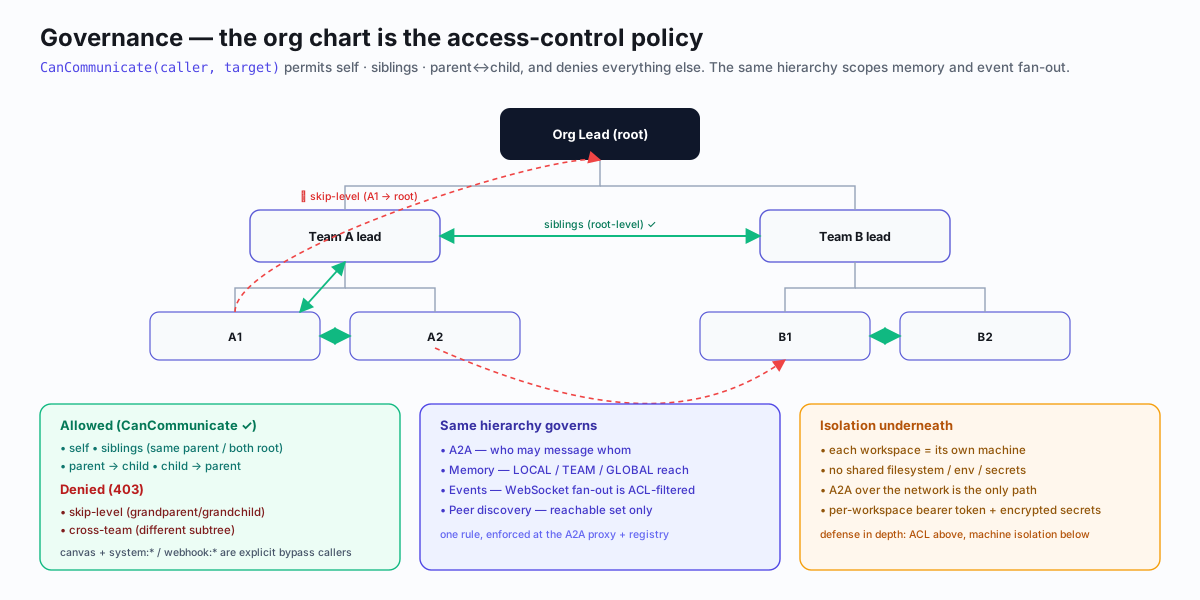
This page documents Molecule AI's coverage of the OWASP Agentic AI Top 10 security risks for AI agents and agentic systems. Coverage is assessed against the platform as shipped — not the roadmap or planned features.
Honest verdict: 5 COVERED / 3 PARTIAL / 2 NOT COVERED
| OWASP ID | Risk | Status |
|---|---|---|
| A01 | Prompt Injection | ✅ COVERED |
| A02 | Sensitive Information Disclosure | ✅ COVERED |
| A03 | Unbounded Resource Consumption | ✅ COVERED |
| A04 | Sandboxing Escapes | ⚠️ PARTIAL |
| A05 | Agent-Human Relationship Dysfunction | ⚠️ PARTIAL |
| A06 | Memory Poisoning | ✅ COVERED |
| A07 | Cascade Hallucinations | ✅ COVERED |
| A08 | Overreliance | ⚠️ PARTIAL |
| A09 | Supply Chain Vulnerabilities | ❌ NOT COVERED |
| A10 | Improper Agency Grants | ❌ NOT COVERED |
A01: Prompt Injection
Risk: An attacker embeds malicious instructions in external data (files, web content, user messages) that the agent treats as authoritative commands.
Molecule AI controls:
- Workspace isolation: Each workspace runs in its own container with an isolated filesystem. A prompt injection in workspace A cannot reach workspace B's memory or secrets.
- Secrets never in tool context: Secrets stored via the platform API are injected into the container's environment at runtime — they are never passed as tool arguments or embedded in LLM prompts where external data might reference them.
- A2A peer validation: A2A messages between workspaces include sender identity verification. Agents cannot impersonate another workspace's agent.
- Admin-level input filtering: The platform API applies input validation before data reaches agent prompts.
Residual risk: Prompt injection within a single workspace (e.g., a malicious file processed by the agent) is not neutralized — this is the responsibility of the agent's own prompt engineering and the LLM's alignment.
A02: Sensitive Information Disclosure
Risk: An agent exposes confidential data — credentials, PII, internal documents — through tool calls, logs, or responses.
Molecule AI controls:
- Encrypted secrets at rest: Workspace secrets are encrypted with
SECRETS_ENCRYPTION_KEY(AES-256) before storage. Plaintext never hits the database. - Secrets scoped per-workspace: A token scoped to workspace A cannot access workspace B's secrets.
- Memory access controls: The MCP server's memory tools respect workspace
boundaries. Agents cannot read another workspace's memory unless explicitly
shared via the
memory_setpeer API. - Langfuse observability: Traces are visible to platform operators; audit
logs show which agent accessed which secret key. Agents should not log
secrets — this is enforced through pre-commit hooks in the workspace template
(the
sk-ant-/ghp_/AKIApattern detector). - Token display-once policy: Workspace bearer tokens are returned in plaintext exactly once at creation and never shown again.
Residual risk: If an agent deliberately calls a tool that prints a secret
value (e.g., echo $SECRET in a shell tool), the platform cannot prevent this.
Agent behavior inside the workspace is ultimately constrained by the tools
exposed and the LLM's instruction following.
A03: Unbounded Resource Consumption
Risk: An agent makes excessive LLM calls, processes unbounded data, or holds memory in a loop, causing cost overruns or DoS.
Molecule AI controls:
- Tier-based resource limits: Each workspace tier has defined memory and CPU caps enforced by the container scheduler. A runaway agent hits OOM before consuming unbounded resources.
- Rate limiting: The platform enforces
RATE_LIMITrequests/min per client. This caps the rate at which agents can issue tool calls or make API requests. - Activity retention and cleanup:
ACTIVITY_RETENTION_DAYS(default 7) andACTIVITY_CLEANUP_INTERVAL_HOURS(default 6) automatically purge old activity logs, preventing unbounded log growth. - Workspace hibernation: Idle workspaces can be hibernated, releasing container resources until the next task arrives.
- LLM cost tracking: Workspace usage is tracked per-token-model, giving operators visibility into spend per workspace.
Residual risk: The platform does not enforce per-request token budgets or LLM call counts within a task. A sophisticated agent can still issue many calls within a single request burst. Operators should monitor Langfuse traces for unusual activity patterns.
A04: Sandboxing Escapes
Risk: An agent escapes the container sandbox and accesses the host system, neighboring containers, or the internal network.
Molecule AI controls:
- Container isolation: Workspace containers are isolated Docker containers on the host. They do not run as privileged and have a non-root default user.
- Bind-mount scoping: The workspace directory is the only host path bind-mounted into the container. Other host paths are not accessible.
- Network namespace isolation: Workspace containers are on a Docker bridge network. Direct access to host services requires explicit platform routing.
Gaps:
- Privileged tier (TIER4):
TIER4_MEMORY_MBworkspaces run with fewer restrictions. A compromised agent in a TIER4 workspace has more ability to probe the host. This is a known trade-off for full-host workloads. - No seccomp/AppArmor/SELinux profiles: The platform does not currently apply mandatory access control profiles beyond Docker's default isolation.
- No egress filtering by default: Workspace containers can reach arbitrary external URLs unless the operator configures network-level egress rules.
Recommendation: For untrusted agents, restrict to TIER2 or below. Configure egress filtering at the Docker host or Kubernetes network policy level.
A05: Agent-Human Relationship Dysfunction
Risk: The human operator loses meaningful oversight of agent actions — the agent acts without notification, makes irreversible decisions, or misrepresents its reasoning.
Molecule AI controls:
- A2A
notify_user: Agents can push notifications to the canvas, keeping the human informed of progress and key decisions. This is an opt-in capability for agents to use. - Langfuse observability: All LLM calls and tool executions are traced. Platform operators can review the full decision trace for any workspace.
- Manual override endpoints: Admins can pause, resume, or terminate any
workspace through the
/admin/*API endpoints. - Activity logs: All agent actions are logged with timestamps and caller identity.
Gaps:
notify_useris not mandatory: The workspace template does not require agents to notify humans of significant actions. An agent can run without ever pushing a canvas notification.- No confirmation gates: The platform does not provide a mechanism for an agent to pause and wait for human approval before taking a consequential action (e.g., deleting a file, sending an external API request).
- No explanation requirements: Agents are not required to log their reasoning before taking actions. Langfuse traces show tool calls but not the agent's internal chain-of-thought unless the agent explicitly logs it.
Recommendation: Configure agents to call notify_user at key decision
points. Monitor Langfuse for silent agent activity.
A06: Memory Poisoning
Risk: An attacker manipulates the agent's memory store to inject malicious instructions or biases that the agent reads back and acts on.
Molecule AI controls:
- Memory write authorization:
memory_setandmemory_set_peerrequire valid workspace authentication. External attackers cannot write to a workspace's memory without a valid token. - Secrets excluded from memory: Secrets are stored separately from the general-purpose memory store and are not readable via the memory tools.
- Per-workspace memory isolation: Memory keys are namespaced to the
workspace. Agents in workspace A cannot write to workspace B's memory unless
an explicit A2A
memory_set_peercall is made from B to A. - Semantic search gating: The
search_memorytool operates only on the authenticated workspace's memory. Cross-workspace search is not permitted without explicit peer delegation.
Residual risk: A compromised or malicious agent within a workspace can overwrite its own memory with poisoned data. This is an agent-level concern, not a platform-level control.
A07: Cascade Hallucinations
Risk: An agent generates incorrect outputs that are fed downstream as ground-truth, compounding errors across multiple agent calls or tool chains.
Molecule AI controls:
- Langfuse trace visibility: All agent outputs and tool call results are captured in Langfuse traces. Operators can identify hallucinated outputs by reviewing traces, especially when downstream tool calls fail or produce implausible results.
- A2A result attribution: A2A delegation responses include the source workspace identity and the full execution trace. Consumers of A2A results can audit where the data came from.
- Human review via canvas: Results surfaced via
notify_useror displayed in the canvas are visible to humans who can flag hallucinated outputs. - Activity logs for audit: All tool call results are logged. If a downstream agent acts on hallucinated data, the chain of events is traceable.
Residual risk: The platform does not automatically detect or flag hallucinations — it provides observability. It is the operator's responsibility to configure confidence thresholds, set up automated result validation where possible, and review traces for signs of cascade errors.
A08: Overreliance
Risk: Users or automated systems trust an agent's outputs without adequate verification, leading to harmful decisions based on incorrect agent outputs.
Molecule AI controls:
- Observable decision traces: Langfuse traces show the full chain of reasoning and tool calls. Downstream consumers can audit outputs before acting on them.
- Canvas notification clarity:
notify_usermessages are human-readable summaries — not raw JSON — which can include uncertainty indicators if the agent is prompted to include them. - Tier-based capability limits: Higher tiers require explicit admin approval to activate, ensuring operators are aware when a workspace has elevated capabilities.
Gaps:
- No automated output verification: The platform does not provide a built-in mechanism for agents to self-verify outputs (e.g., cross-checking a code generation against a linter before returning).
- No confidence scoring surface: The platform does not currently surface LLM confidence or probability scores in a structured way. Agents that include confidence in their outputs are relying on prompting alone.
- No policy enforcement on agent outputs: There is no platform-level mechanism to reject agent outputs that violate defined policies before they are acted upon.
Recommendation: Prompt agents to include uncertainty flags and self-check steps. Configure downstream systems to require human review for high-stakes agent outputs.
A09: Supply Chain Vulnerabilities
Risk: Vulnerable or malicious dependencies in the agent toolchain — workspace runtime packages, plugins, adapter libraries, or LLM provider SDKs.
Molecule AI's position: This risk is inherited from the broader software supply chain and is not specifically addressed by the platform at this time.
What operators must manage independently:
- Workspace runtime dependencies (
molecule-ai-workspace-runtimeand its transitive dependencies) - Plugin dependencies (see SAFE-MCP Advisory: G-01)
- Workspace template adapter dependencies (Python packages installed by adapter-specific Dockerfiles)
- LLM provider SDKs and their transitive dependencies
Mitigation operators should apply:
- Pin all Python and npm dependencies to exact versions in workspace templates and plugins
- Use
npm ci/pip freezeand commit lockfiles - Subscribe to security advisories for all runtime dependencies
- Scan container images for known CVEs before deploying
A10: Improper Agency Grants
Risk: An agent is granted more agency (capability to take actions, access resources, make changes) than it needs — creating blast radius if the agent is compromised or misbehaves.
Molecule AI's position: The platform provides the building blocks for least-privilege agent design (tier-based caps, per-workspace secrets, scoped tokens, memory isolation) but does not enforce least-privilege agency at the agent action level.
Gaps:
- No action-level RBAC: The MCP server exposes all 87 tools to all
authenticated workspaces. There is no mechanism to restrict a specific
agent's access to a subset of tools (e.g., blocking
delete_workspaceorsend_channel_messagefor a read-only agent). - No approval workflow for high-impact actions: The platform does not support requiring human approval before an agent executes a high-impact tool (e.g., deleting a resource, sending an external API request, modifying a secret).
- Admin tokens are all-or-nothing: The
ADMIN_TOKENgates all/admin/*endpoints. There is no concept of scoped admin tokens with per-endpoint permissions. - Plugins have full workspace access: Once a plugin is installed, it executes within the workspace context with access to all workspace tools and secrets.
Recommendation: Apply defense in depth — restrict MCP tool exposure at the agent configuration level, use workspace tiers to limit container capabilities, and review plugin manifests before installation (see SAFE-MCP Advisory: G-02).
Coverage methodology
This report was produced by Research Lead (2026-04-18) reviewing platform source code, configuration defaults, and the deployed security posture against each OWASP Agentic AI Top 10 category.
"COVERED" means the platform provides specific, built-in controls that mitigate the risk, even if residual risk remains at the agent behavior level.
"PARTIAL" means the platform provides some controls but significant gaps remain that operators must address through configuration or complementary tooling.
"NOT COVERED" means the risk is not addressed by the platform as shipped. Operators must manage it independently.
Reporting gaps
If you believe a coverage assessment is incorrect or want to propose a new
control for a gap, open an issue in Molecule-AI/molecule-core tagged
security or reach out through your support channel.